
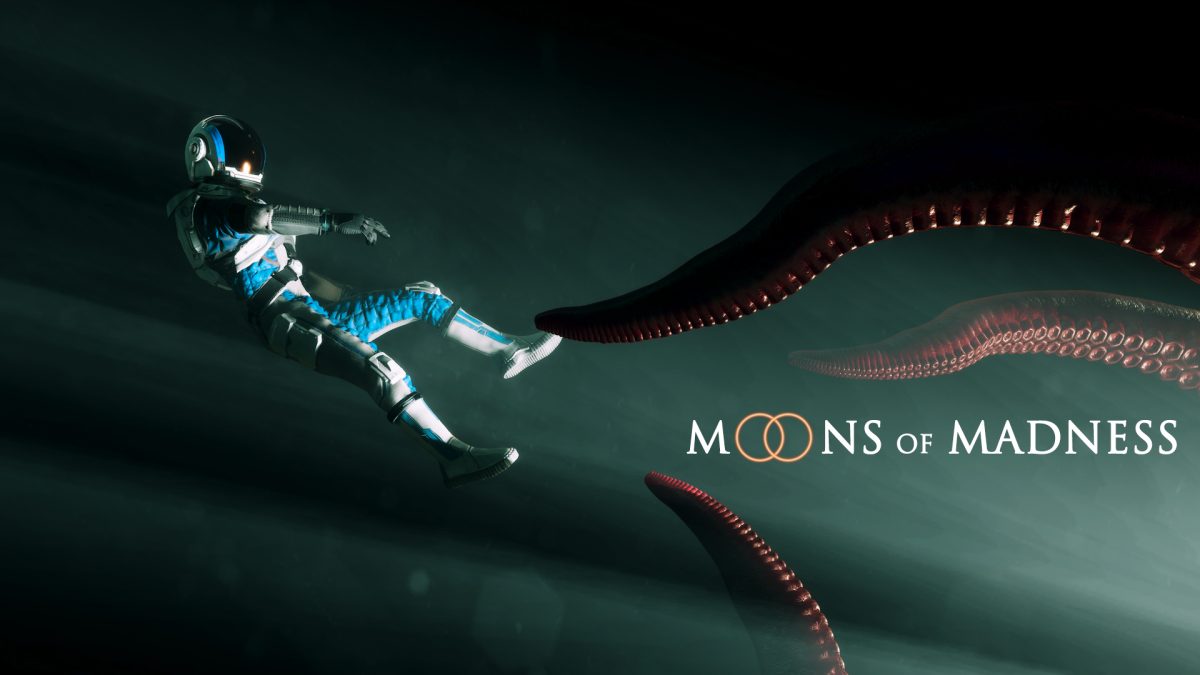
December 29th, 2020, I bought a game called Moons of Madness which is a first-person narrative-driven Sci-Fi game with a Lovecraftian twist where you’re a mechanical engineer on a Mars space station fixing machines that seem to never do what they’re supposed to do while your colleagues get to do all the exciting parts, like researching how plants grow in Martian soil or finding out whether or not there are/were microbes and bacteria on Mars.
Last night, I finally got around to play this game as it was part of the stretch goals during my last charity campaign for No Kid Hungry. So, we embarked onto our mission to Mars, and I was positively surprised by my experience on the red planet.
I mean, yes, I experienced a nightmare right in the beginning, with visions of a dark and deteriorating space station as well as a witch nearly making me shit myself, but after that nightmare was over, it was all very chill: Just me exploring the station, talking to colleagues on the radio, and eventually heading out to fix the solar arrays that were out of sync… again… Why can’t tech just work how it’s supposed to?
But little did I know how quickly that aforementioned nightmare sequence would turn into a reality for me…
Developer: Rock Pocket Games
Publisher: Funcom
Genre: First-Person Sci-Fi Horror Adventurer
Release Date: October 22nd, 2019
Reviewed on: PC
Available on: PC, PS4, XB1
Copy was purchased.

The day started off just like any other with us fixing one of the many things that keep breaking amongst this blasted space station. You’d think that such an expensive research operation would have functioning equipment but as it turns out it’s our job to fix whatever breaks whenever it breaks.
Hence, we link up with and calibrate the various solar panels, tilt them just the right way to reach optimal efficiency, and then head back to base where the Greenhouse is getting flooded due to the reclaimer not working correctly. Follow the coloured pipes, pick up the different pieces, spy a look at your colleagues’ computers, put the pieces in place to fix the reclaimer, and Boom! We’re done here. Back to relaxing in our cabin, I’d say, if it wasn’t for the strange state of the greenhouse.
This place is overgrown as heck, the mangroves are heavily mutated by some black goo, the researcher responsible, Inna Volkova, appears to have gone mad and this plant-monster is chasing after us! With no means of fighting back, we have to run away, dodge tendrils after tendrils, crawl through the vents, and somehow… we make it back. Something has gone horribly wrong here… we have to warn the others.

Moons of Madness is a game about isolation and trauma, I would say. Everything in this game makes you feel how desperate the situation is. The atmosphere is tense throughout the game with some quieter moments breaking apart the episodes you encounter. With its chapter-based structure, Moons of Madness enables you to find good points to take a break and continue later… but I also was just so hooked from the game that I played through its entire eight hours of playtime in one sitting. It was just that good.
Typically with horror survival-y games, you are stranded somewhere and there is definitely a way out… but with Moons of Madness you don’t get that feeling.
For one, you’re on a giant red planet where even leaving the base requires you to put on a helmet, adjust the pressure, and refill your oxygen before you open up the airlock door. This isn’t Earth, after all, and the game really manages to hammer that home for you… and because this isn’t Earth, help won’t come if you can’t find a solution to the issues. You’re very, very, very far away from Earth… and as such, the situation feels even more desperate!
Similarly, when you look outside, you just see these vast red areas with sand storms, craters, a lot of rocks, and two moons circling the planet at all times… Phobos and Deimos, Fear and Dread, are incredibly fitting for the core inspiration of this game. The game really manages to tap into H.P. Lovecraft’s cosmic horror while not name-dropping the eldritch gods from said mythos at every minute.

What makes Lovecraft’s works great is the sense of looming dread, the fear of the unknown and unfathomable, as well as the thick tension. Rock Pocket Games’ work embraces these ideas in various nightmare and dream sequences, set in incomprehensible worlds of darkness and illusions, each with mechanics of their own.
These flashbacks to your past or visions of the future round out each episode fairly well and provide you with some clues to piece together the story while also accentuating the intense chase sequences and stealth sections or the more relaxed exploration and puzzle sections.
Speaking of puzzles, though, Moons of Madness sometimes tends to overcomplicate matters. Some of the puzzles are fairly easy to solve, others, on the other hand, can really make you want to scratch your eyes out with how obtuse and sometimes plain intuitive they are.
In one section, for instance, the centrifuge you use needs to be balanced to work, and it took me a good while to realise that it means that the cannisters need to be on equal sides. Visually, however, you don’t see that the thing is not balanced. This would have been a matter of better show than tell.

The game is rather linear in its design. You get the illusion that you can go anywhere you want – if oxygen levels and terrain permit, that is – but you essentially are playing a Walking Simulator which hampers immersion a little bit. The game’s atmosphere is intense most of the time and really adds to that but you still get pulled out frequently with the main character, Shane, narrating what he does or why something doesn’t work in ways that feel very much like you’re playing a game rather than experiencing a story.
That being said, the game-like self-narration did remind me a little bit of older games that would do the same kind of thing frequently, including Nibiru, The Longest Journey, and Call of Cthulhu: Dark Corners of Earth. In a way, it felt nostalgic and charming… but in the grand scheme of things, it’s a little annoying how it removes you from the immersion.
The story also tends to unravel rather quickly, sometimes not giving you enough time to think about what is happening at times. On top of that, a twist near the end was rather easy to spot, and some parts of the game made me feel a bit confused. The ending as a whole felt a bit abrupt and anticlimactic, even if I’ve felt that the game and its puzzles overstayed their welcome somewhat.
Another thing that sort of bothered me was that certain things just kept getting mentioned as a side remark without any intention of getting resolved. There’s a reveal of sorts that the company we work for, Orochi, had other side projects going on, including ways of replacing the crew. There were mentions of someone’s backstory that felt incredibly out of place and disturbing but not in the “oh, they went through that” kind of way but more in a “if this wasn’t in the game, nobody would notice and everyone would be happy” kind of way. The game just kept opening barrels but never intended to pour any of the insides out which left me unsatisfied in a way. So, if you play the game, just realise that not all plot points get resolved when they’re mentioned only once.

All of that said, Moons of Madness really drives home that feeling of isolation and creeping madness. It’s an interesting take on Lovecraft’s cosmic horror, and it manages really well to tap into what makes his ethos interesting without name-dropping Cthulhu (well, technically…) and without solely relying on tendrils and tentacles in its design.
I’d say that it’s definitely a game worth experiencing, especially with its shorter runtime that doesn’t overstay its welcome too much. Yes, some puzzles can be a bit obtuse, and your immersion might break from the self-narration and the game-iness of the, well, game… but it’s an interesting horror experience that I’m glad to have finally played.
This post was originally written by Dan Dicere from Indiecator.
If you see this article anywhere other than Indiecator.org then this article has been scraped. Please let me know about this via E-Mail.
 Indiecator
Leave a comment