For the longest time, strategy games have sort of filled a niche in the market, often either being too simplistic to be entertaining for strategy fan appeal or too complex for casuals to get into, and in more recent years, I believe this changed to a certain degree with the appearance of more accessible entries into the genre, allowing us to enjoy a great many strategy games beyond staples like Fire Emblem and Final Fantasy Tactics.
It’s very refreshing to see new games in the genre pop up and attain success with new takes on gameplay, interesting stories, and a lot of panache.
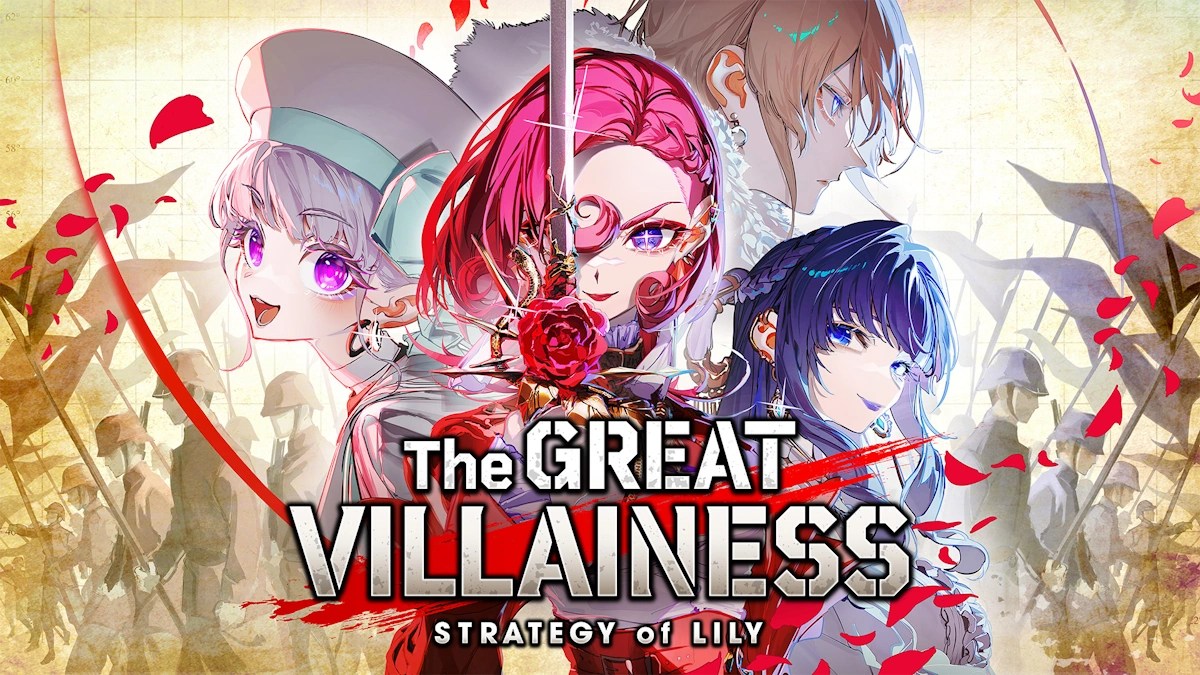
Speaking of panache, The Great Villainess: Strategy of Lily is a game just dripping with it, fusing military strategy and turn-based combat with, on top of all of the straightforwardness and flair you can get from anime tropes and various game influences. On paper, it’s an interesting title with you leading an insurrection against an empire turned against you, but does it hold up to the premise? Let’s dive into it.
Developer: One or Eight, WSS Playground, Alliance Arts
Publisher: Alliance Arts
Genre: Indie, Tactical RPG, War Sim, Turn-Based Tactics, Anime
Release Date: July 24th, 2025
Reviewed on: PC
Available on: PC
Copy was provided by StridePR.
Strategy of Lily takes place in a far-off kingdom amidst a great catastrophe.
The emperor was assassinated, the capital is in flames, and the prince’s retinue encounters the mad duchess Scarlet, who doesn’t exactly confess to being the culprit behind the chaos but also doesn’t really help lift suspicions, further complicating the matter of finding the real culprit behind this immensely. Combat ensues and, as it turns out, Scarlet is strong. Very much so. A perfectly bona fide villainess has to be strong, after all. The attempts to apprehend her don’t go well, basically.
Scarlet, however, then turns her attention to Lily, an engineer present at the scene of the crime, and kills her, sending both of them into some type of purgatory where they can reflect on the story, their actions and their feelings.
As it turns out, Scarlet’s and Lily’s fates have been entangled, meaning it is “game over” for both of them when either of them dies. You get another chance at life with the ability to restart from a prior save point. Rather than just storm the area and plunge into battle, Lily joins Scarlet in battle as a valued strategist with the plan to retake the empire in a growing insurrection to prove her innocence, gather allies, and find the real culprit!
Look, the story is very “anime”, so if you’re not a fan of enemies-turned-to-allies tropes and very over-the-top characters, this could come across as a bit jarring, but the game is a ton of fun and features a plethora of mechanics, twists and turns that make it worthwhile pulling through. Personally, I loved the absolute madness the story provides. Is it whacky? Yes. Do I mind? Not at all, whatsoever.

The game also lets you decide whether you want more allies or whether you kill your enemies, granting you better stats at the cost of making the game harder on a strategic level, with different endings depending on the choices made, though in reality, there really are just two endings – “gotta catch ’em all… or don’t”, basically.
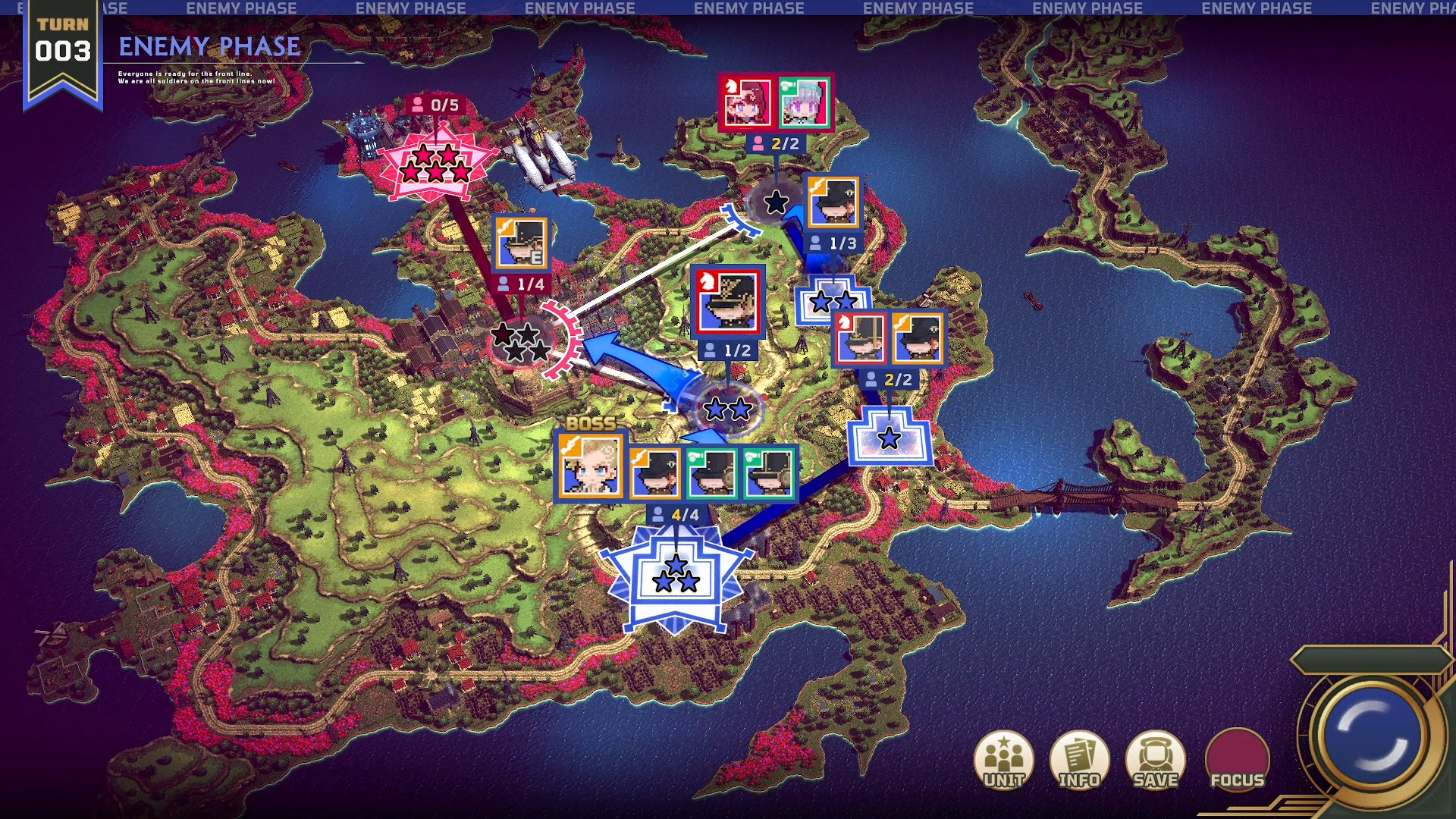
The core gameplay takes place on a map with a series of board-game-like spaces that you get to move your units to and from. Initially, you only start with Scarlet and Lily, but as you overtake cities and whole regions, you’ll gain allies that aid you in your insurrection endeavours, each coming with their own sets of passive and active abilities.
Combat is centred around a Fire Emblem-esque weapon triangle (Cannons, Cavalry and Infantry) as well as three-turn encounters. Attacking units you’re strong against results in a damage boost. When a unit is attacked by a unit it’s strong against, it can counterattack.
Within three turns, you’ll have the chance to whittle down or outright defeat the enemy, giving you the ability to occupy and recapture the space, or defend your occupied lands from the enemy forces. What I find very interesting about the three-turn time limit is that it keeps encounters (of which there are a great many!) to a small yet satisfying time frame. If you’re defending against incoming invaders, you could theoretically just stall, but more often than not, the game rewards aggression, even when you’re under siege.
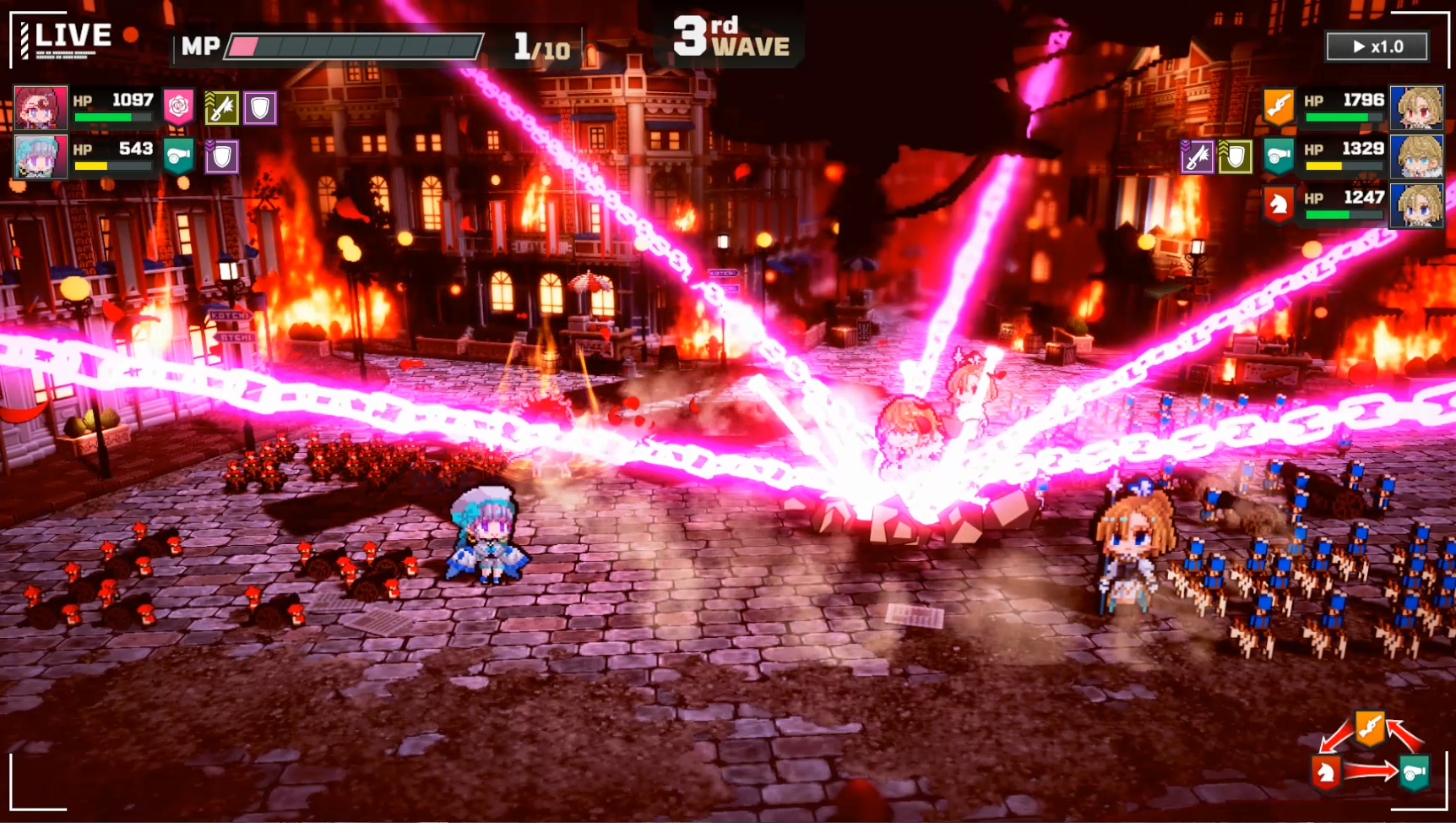
Besides using normal attacks, each unit can also utilise their abilities, costing you MP, which you primarily generate by attacking or defeating enemies, as well as defending when you get attacked.
The strongest abilities can’t be used right from the get-go, often requiring you to wait until turn 2, and Scarlet, for instance, has one that lets her gain the advantage against all units, while also healing herself and boosting her stats. It’s very strong, especially when you think about that counter-attack mechanic I mentioned.
The game further incentivises more aggressive tactics, with the health of your units directly correlating to how much damage they deal.
It reminded me of the Endless series, amongst other strategy titles, where a damaged army has fewer individual units and, as such, won’t be able to attack as hard. Makes sense, right? Enemy intent can be seen ahead of time, and at times people will focus their efforts on one individual unit, which may prompt you to spend your turn defending, generating more MP… But because of how the game is designed, attacking to whittle down their numbers with your other units and hence reduce their attack power is heavily incentivised.

Now, as I previously alluded to, The Great Villainess: Strategy of Lily is very “anime” in its premise, story and the various tropes it uses. Character backstories and the main plot feel very inspired, which doesn’t have to be a bad thing.
I enjoyed it for the most part, especially as a genuine Otomege-Isekai enjoyer. I don’t think that the straightforwardness of the story is necessarily a bad thing either, as it makes it easier for players of all sorts of walks of life to understand and enjoy it.
Furthermore, the fun and interesting combat encounters paired with the straightforward narrative are glued together by an immaculate presentation that just wasn’t what I expected from an indie game.
When I said this game is dripping with flair… I meant it!
From a fully voiced cast featuring amazing performers like Nonoka Obuchi (Too Many Losing Heroines!, Mysterious Disappearances), Hikaru Iida (Trails in the Sky, Gakuen Idolmaster), Sally Amaki (May I Ask for One Final Thing?, MHA: Vigilantes), Yurina Amami (Death Mount Death Play, Eren the Southpaw), and many other talented individuals to the impactful animations and fun cutscenes, the very fitting music by U2 Akiyama, and the amazing art by Rolua (gosh, I love their art)… the game’s got it all.
It’s just great to see the amount of effort put into the smaller and larger details, and it works really well to sell the experience for the game. Rolua’s art in particular really drew me into the game. I’m just a huge fan of that artist now. The characters even blink at times. It’s a very small thing, yes, but it does so much in terms of immersion for me.
All in all, The Great Villainess: Strategy of Lily is a game that works really well because of how everything plays together, but it’s not perfect by any means.

There’s this whole airship mechanic where you can stream combat and do propaganda or even capture enemy units, but it feels a bit clunky to use at times, with its radius sometimes being just a smidge too short to cover multiple areas – I get that that’s a nitpick, but it bothered me a little bit too much throughout my playtime.
Another thing for me was that greater difficulties were really not worth playing or rewarding at all, as they just made the game grindier rather than more challenging. Enemy units scale harder, so you grind more, basically, and all of a sudden you’re at square one. Instead, I would have very much welcomed a Fire Emblem-style Perma-Death-Mode, although the “bad route” is arguably like that inadvertently. That would have been much better. Luckily, you can change your difficulty halfway through.
Beyond that, the CPU also will oftentimes just throw things at you until you change your strategy, though this becomes less of an issue when you experiment with different unit compositions. Sometimes a certain group just worked better, and even if Scarlet is sort of broken, that doesn’t mean that she can only attack, right? When a change I made suddenly worked, it felt incredibly rewarding as it also allowed me to clean house on those who stood in my way!

All of these “issues” are really just nitpicks, though. I loved this game thoroughly and can’t wait to play more of what the developers have in store for us in the future. Again, it’s a pleasure to look at and listen to. Presentation, of course, isn’t everything in a game, but it definitely doesn’t hurt the game!
The story is very straightforward and simplistic, but all the more amusing and, at times, even surprising. The gameplay feels like a great entry into the strategy genre, without any of the bloat that makes more complex titles so intimidating to get into. Yes, the inspirations are very clear, but all in all… While The Great Villainess: Strategy of Lily doesn’t reinvent the wheel, it very much excels in creating a fun and satisfying experience with inspirations that add up to more than the sum of their parts.
Verdict: The Great Villainess: Strategy of Lily is a fun, straightforward, and "very anime" experience with cool combat mechanics, interesting characters, and a lot of flair. The simplistic narrative, use of tropes, and combat mechanics work as well together because of how the general feel of the game and the presentation glue it together. I do very much recommend this to strategy game enjoyers and fans of Otomege-Isekais alike.
This post was originally published on Indiecator.
If you wanna get in touch with me, feel free to stop by for one of my Twitch streams. For business inquiries, please reach out via email.


Leave a Reply