
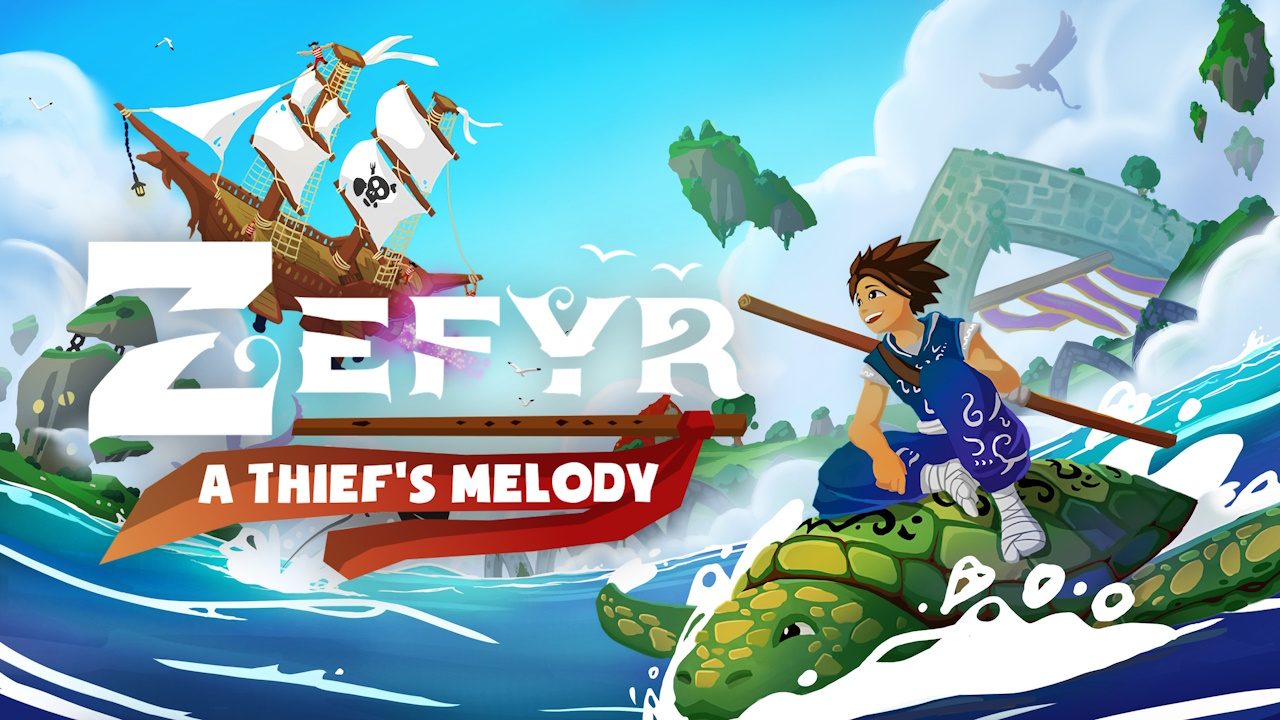
In the ever-growing world of indie games, where creativity often blossoms beyond the constraints of large studio expectations, Zefyr: A Thief’s Melody stands out as a vivid testament to the power of solo development and passionate storytelling. Created by Mathias Fontmarty under the studio name Oneiric Worlds, Zefyr is not merely a game but an invitation to slow down, explore, and savour a world crafted with care, humour, and emotional depth.
Developer: Oneiric Worlds
Publisher: Oneiric Worlds
Genre: Indie, 3D Platformer, Adventure
Release Date: June 2nd, 2025
Reviewed on: PC
Available on: PC
Copy was provided by the developer.
Inspired by beloved classics like The Legend of Zelda: Wind Waker, Sly Cooper, and Beyond Good & Evil, this charming action-adventure game offers players a colourful, tranquil, and thoughtful journey – one that gently subverts modern gaming norms in favour of heart and atmosphere.

Set across a beautiful archipelago, Zefyr introduces us to a whimsical universe where thieves collect flowers and help out biologists, pirates roam the skies, and ancient secrets lie tucked away behind waterfalls and mountain paths. You play as Eïko, a young thief-in-training who stumbles into a conspiracy far more dangerous than they bargained for. At first glance, Eïko’s journey may seem like a classic hero’s tale – but Zefyr offers more than a simple narrative arc. It is a meditation on kindness, curiosity, and our connection to the natural world.
From the outset, the game’s aesthetic sets the tone. With a cel-shaded, pastel-infused art style, the visual palette feels like a watercolour painting coming to life. The character designs are stylized, almost reminiscent of late PSX-era adventure games – evoking a warm nostalgia without sacrificing modern polish. The vivid colours accentuate the islands brimming with life, whether it’s birds soaring overhead, sick animals in need of healing, or environmental details that gently reward the observant player. This attention to atmosphere doesn’t just serve as a backdrop but becomes part of the emotional vocabulary of the game.

But aesthetics alone don’t make a compelling adventure. What makes Zefyr shine is its gameplay structure, which smartly blends exploration, stealth, and puzzle-solving into a cohesive and highly playable experience. While Eïko can sneak past enemies or engage them directly, the game encourages creativity and choice, without punishing players for taking a more pacifist approach. There is an openness to its design, literally and metaphorically. Most environments allow for climbing, jumping, and grappling with surprising freedom.
This verticality makes traversal feel fluid and empowers players to engage with the world in a way that feels playful and liberating. There are no double jumps or unlocks as you might see them in most more modern titles. Instead, you have Zelda-style dungeons where you solve puzzles, are introduced to new mechanics, unlock new abilities, and then utilize said abilties in smart and rather engaging ways.

Zefyr: A Thief’s Melody, however, doesn’t merely take inspiration from other games but it also innovates. Perhaps one of its most iconic mechanics – and it is most delightfully whimsical – is the ability to travel between islands by riding on the back of a giant turtle. This slow, gentle form of navigation is emblematic of the game’s larger ethos: Zefyr does not rush you. It encourages reflection and curiosity, placing equal value on reaching your next objective and enjoying the journey along the way. In a gaming landscape often obsessed with fast travel and high-octane action, Zefyr offers a rare pause.
Furthermore, the game still allows you to use fast travel if you do indeed hurry for the next adventure, but it’s a choice rather than the only viable option, and at times, you might just have to combine the two if you want to reach a place that isn’t accessible yet.

Interwoven with its core mechanics is a sense of gentle urgency in the story. As Eïko uncovers the layered mystery of her world – meeting colourful characters, confronting pirates, and uncovering ancient relics – she’s also healing, learning, and growing. There’s no grim darkness or excessive cynicism here, which makes its emotional moments land even more powerfully. The game never talks down to its players. Instead, it trusts them to engage with its themes, including compassion, environmentalism, and responsibility, at their own pace. In many ways, the game feels like an interactive children’s novel – one that, in my opinion, adults will find just as moving, probably.
So, to summarise my review so far, Zefyr: A Thief’s Melody is a game that rewards exploration and creativity, allowing you to approach situations stealthily or head-on. Nearly every wall is climbable, and the game doesn’t really make use of invisible walls, which further helps with immersion and incentivising creative solutions to the variety of obstacles the player may face.

Overall, it is a very polished experience that is well-designed both in terms of gameplay and world-building, but despite that, there are a few little nitpicks I have. For one, I have no idea why we’re thieves, why thieves are not bad guys, and what makes a painting-stealing thief better than a plundering pirate… “Oh well…” These and other questions are often left unanswered and I wish there was just more lore in the game.
Another minor issue I had with the game was that the music just wouldn’t play for a good while, and it just seemed like the game sometimes forgot to loop a track or something.

Outside of these smaller issues, I did find the game to be fairly easy in terms of combat. The puzzles were all pretty neat in terms of complexity. Not too hard, not too easy. The sweet spot. Sometimes things would take me a while to figure out, but they were still very much fun and definitely reminded me of Zelda in terms of design and structure. I could also see the inspiration the developer took from Beyond Good & Evil (great game!) with the animal cataloguing, the various collectables, and the bo(staff)-centric combat, although I wish that there was an option to increase the difficulty for combat a bit.
And well, the animations are a bit janky at times – but, personally, I found that pretty adorable. It would have been neat if Eïko was at least doing a surfing motion or something on the turtle or perhaps moved less rigidly… but I don’t mind a little jank, and it gave me a good few chuckles along the way. I’ve seen worse from bigger studios.

That said, I do not think that these minor issues outweigh the many positives that Zefyr: A Thief’s Melody has going for it. It’s a very well-balanced game and a heartfelt adventure that encourages exploration, empathy, and joy.
It’s perhaps not the loudest or most groundbreaking title of its generation, but it surely shows a lot of soul and really manages to bring across how much passion and effort the sole developer behind this game poured into it.
Zefyr: A Thief’s Melody takes a lot of inspiration from other games but feels like much, much more than the sum of its parts… and more than anything, it offers a rather accessible, magical world to get lost in, welcoming all types of players with open arms (and a giant turtle to ride), which I found rather great.
This post was originally written by Dan Dicere from Indiecator.
If you see this article anywhere other than Indiecator.org then this article has been scraped. Please let me know about this via E-Mail.
 Indiecator
Leave a comment