
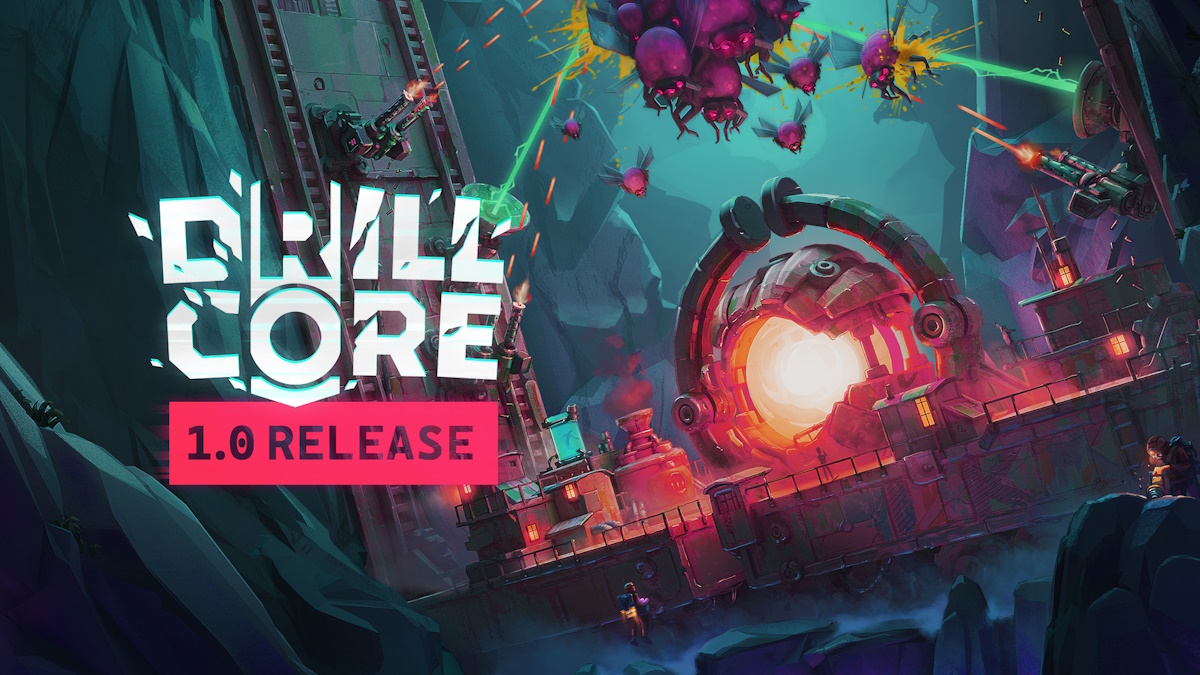
The first time I played Drill Core during June 2024’s Steam Next Fest, I knew I’d stumbled onto something special. Hungry Couch Games’ mix of roguelite exploration, colony-sim-like strategy and management as well as tower defence chaos hooked me instantly. The demo for Drill Core was followed by an update-rich Early Access period not long after. On July 17th 2025, it officially hit its version 1.0 with a wealth of new features.
It’s an addictive experience, combining Deep Rock Galactic-style corporate humour with a dazzling array of unique synergies between perks, buildings and towers. Today, I wanted to share why I love Drill Core so much, and why I think it deserves a spot on your list if you’re hunting for your next big roguelite-tower-defence obsession.
Developer: Hungry Couch Games
Publisher: tinyBuild
Genre: Indie, Roguelite, Strategy, Tower Defense
Release Date: July 17th, 2025
Reviewed on: PC
Available on: PC
Copy was purchased.

What, actually, is DrillCore about, you may ask? In Drill Core, you command miners, carriers, and guards working for the titular company. The job? “Fixing” planets by detonating a massive core deep in the mantle to correct their magnetic fields and environmental issues. How does it work? No clue. Do you get paid? Well… corporate says you do.
Your missions take you to different planets to dig deep and strike it rich. By day, you mine resources and invest them in buildings, either general infrastructure (for production, research, and other effects) or defensive structures (to protect your base). By night, the local wildlife makes it abundantly clear they don’t appreciate your noise, launching waves of increasingly tough attacks. Your turrets and units have to hold the line until daylight returns.

Your ultimate goal is to dig to the target depth and blow up the core. Progress depends on finding the coal necessary to dig deeper. Along the way, you’ll collect tech for perks and run-specific upgrades, permanent resources (yellow, cyan, and purple) for post-run upgrades, and your bread-and-butter materials, iron and swarmlit, for building.
Procedurally generated mines ensure no two runs look the same. Hazards are plentiful, ranging from cave-ins and fires to hostile fauna and massive worms that emerge at night to swallow units whole. Layered on top are difficulty modifiers: The higher the challenge, the more bonuses and penalties you’ll juggle. Random events between shifts can further disrupt (or occasionally help) your plans.
On paper, Drill Core is simple: Dig deep, defend your base, blow up the core. But beneath that straightforward loop lies a wealth of run-to-run variety. Each difficulty offers three distinct planets with unique challenges. You’ll choose between different cores, crews, starting builds, and bonuses, letting you tailor your runs to your preferred playstyle.

For me, the real beauty is in the strategies you can craft. Whether I’m experimenting with crew compositions, leaning into specific perk synergies, or trying unconventional builds, Drill Core feels as deep as I want it to be. As someone who loves tinkering with systems and optimising runs, it’s been a dream come true.
I love experimenting with the base defences. Sometimes I’ll line the field with energy turrets, creating walls of lasers that melt anything crossing their path before using teleport turrets to send enemies right back through the same deadly beams. Other runs have me deploying short-range powerhouses paired with harpoon launchers that drag targets into the kill zone. And sometimes, it’s all about turning machine-gun turrets into rapid-fire monstrosities that shred entire waves.
Every turret can be upgraded in multiple ways, too, and you can set target priorities to focus on specific threats, adding yet another layer of tactical depth to each build.

My biggest gripe with Drill Core is its progression system. If you’ve followed my blog for a while, you’ll know I’m not a fan of permanent progression in roguelikes—it often delays the fun parts just to stretch out the game’s lifespan. Done well, it can ease players into complex systems without overwhelming them. Done poorly, it just feels like padding. Drill Core, unfortunately, has three separate meta-progression systems competing for your attention.
1. The Resource Tree – Using permanent resources found in the mines, you unlock gameplay features like letting workers stay out at night, adding rerolls, new tech, and starting aids. These don’t take long to acquire, but it’s frustrating that basic quality-of-life features are locked behind this tree at all.
2. Crew Level-Ups – Each crew gains XP as you use them, unlocking class-specific perks and mechanics. Once you’ve levelled up enough, you still have to spend resources to activate those bonuses. If you’ve played a lot (like I have), the XP gate just feels like busywork.
3. Department Unlocks – Choosing a department lets you unlock new buildings over time. It’s a neat idea, but easy to forget about, honestly. And once everything’s unlocked, the permanent resources you unluck with this system also become meaningless. It ties well into the other systems, since you have no expenditures of resources here but gives you resources to spend elsewhere… but the resources don’t do anything for you if you have already unlocked everything else, so there’s that, too.

That’s three separate upgrade tracks (THREE!) which can easily overwhelm new players. If it were up to me, I’d scrap the XP gate for class upgrades (and just raise their cost), and I’d make key resource-tree features, like the night shift or the ability to direct guards, available from the start.
Working toward rewards can be satisfying, but once you’ve unlocked everything, you’re just mining permanent resources that serve no purpose. Heck, give me an option to automatically forbid my carriers from carrying permanent resources. I don’t need them. Go carry the iron, instead!

Beyond that, I don’t have many complaints about Drill Core.
In theory, you can softlock a run if you run out of resources to hire workers and have no workers left to keep progressing – but that’s more of a rare “watch out for this” situation than a deal-breaker. The quick-restart option helps keep downtime minimal. And with its appealing pixel art and fitting soundtrack, the game’s presentation matches its addictive gameplay.
It’s simply a great time that I highly recommend without any major gripes beyond those detailed up there.
Drill Core thrives on its satisfying blend of mining, base-building, and tower-defense mayhem, all wrapped in a layer of cheeky corporate humor. Its procedural map generation, hazard variety, and wealth of strategic options, from laser walls and rapid bombardment to harpoon traps and machine gun slaughter, make each run feel distinct. While the triple-layered progression system can feel like unnecessary busywork, the core gameplay loop is so engaging, and the strategic depth so rewarding, that it’s easy to sink hour after hour into “just one more run.” If you enjoy roguelites that give you room to experiment, adapt, and laugh along the way, Drill Core is well worth drilling into.
This post was originally written by Dan Dicere from Indiecator.
If you see this article anywhere other than Indiecator.org then this article has been scraped. Please let me know about this via E-Mail.
 Indiecator