
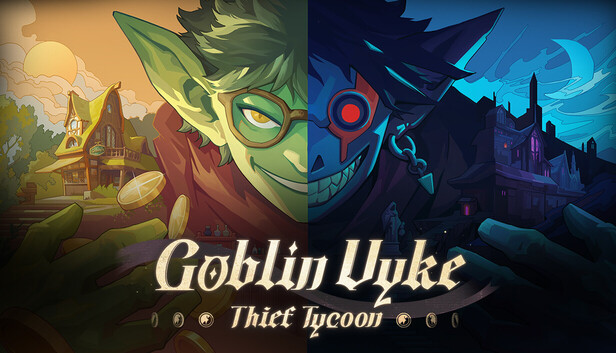
There is something truly magical about a game that captures the essence of several titles I love without ever feeling like a mere imitation, and Goblin Vyke manages that effortlessly. I came away genuinely impressed.
While it shares surface similarities with Recettear and Moonlighter’s “dungeon diving by night, selling by day” loop, Goblin Vyke feels like a fresh take on the formula thanks to its slick presentation, strong storytelling, deep customisation, and, most importantly, its complete focus on stealth instead of combat.
Developer: Art Thieves
Publisher: Art Thieves
Genre: Indie, 2D, Stealth, Metroidvania, Shop Keeping Dungeon Crawler
Release Date: Q1 2026
Reviewed on: PC
Available on: PC
I review the (free) demo here.
I immediately fell in love with Goblin Vyke’s world once I realised just how cruel it is. Your father has just died, and the banker who tricked him into a predatory mortgage wastes no time demanding ownership of your shop. Rather than stopping there, the loan shark actively revels in your desperation, clearly enjoying every moment of your misery. It’s a grim setup, but one that perfectly frames the game’s central theme: Greed.
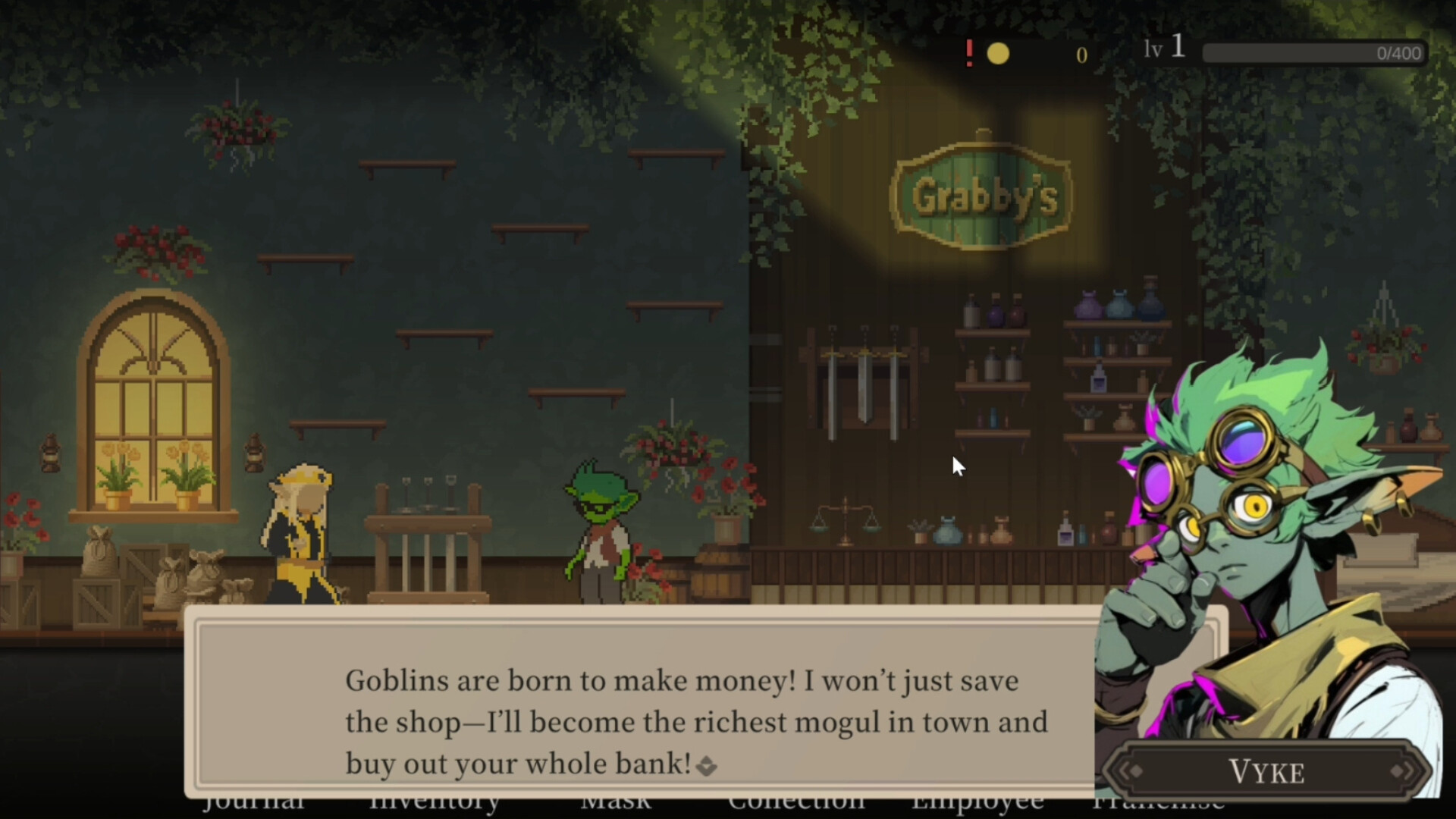
Your pride as a goblin merchant, combined with your love for your father, who tried to succeed as an honest merchant, leaves you with little to no choice but to embrace that greed yourself. Not only to reclaim your shop, but also to take revenge on the man who prompted your father to work himself to death. That motivation bleeds seamlessly into the gameplay loop. Each night, you sneak into the local dungeon to steal valuables from enemies and adventurers alike, then sell your ill-got gains during the day. Death is forgiving but not free: thanks to your magical mask, you’ll return safely, but only the contents of your limited “death bag” can be recovered. As such, you walk a tightrope of maximising profits at the risk of losing it all. Greed is king, so to speak.
The dungeon itself features a fixed layout filled with traps, enemies, secrets, and shortcuts, akin to other metroidvania games. Certain areas require abilities unlocked through your shop, while others demand patience, precise timing, or clever manoeuvring. Dodge massive rolling boulders, slip past alarms, and carefully avoid deadly spike traps, all without ever drawing a weapon.
It’s a stealth-first design that constantly asks you to slow down, observe, and take calculated risks.
Many of the game’s mechanics exist to support that tension. Coin beetles, for example, can be used to distract enemies, set traps, or escape danger, and unlock additional functions over time. Pickpocketing enemies involves a small timing-based minigame that lets you steal their weapons and loot mid-encounter, as long as enemies are unaware of you. Disarming an enemy reduces them to dealing minimal damage with their fists, which is both mechanically satisfying and a little bit funny. Take too long with this minigame or the actual looting, and the enemy will spot you. On top of that, you may even add items into the enemies’ inventory that blow up after a while or produce a lot of smoke for the next thirty seconds.

What truly hooked me, though, is how Goblin Vyke rewards – and punishes – greed.
More often than not, I’d find myself deep in the dungeon with a full inventory and critically low HP, debating whether to leave safely or push forward just a little further. Maybe there’s another shortcut. Maybe a new teleport point. Maybe better loot. I’ve spent far too much time on one HP and a dream, and the game consistently got my blood pumping in the same way Deadbolt or Hitman’s stealth systems do when things go even slightly wrong.
More than anything, though, I’ve been having a blast getting better and better at the game, and really realising just how much this game not just rewards but also challenges you for displaying excessive amounts of greed. I could, of course, leave the dungeon with my filled inventory and very low HP but what if I make more progress into the dungeon, find a new teleport point or shortcut, and also get much better loot instead? I’ve spent too much time on one HP and a dream in this game, and it just really managed to get my blood pumping much akin to how Deadbolt’s and Hitman’s stealth gameplay made me feel.
Exploration usually pays off with chests or permanent shortcuts, charms to customize your playstyle, or bits of lore. Mimics, while deadly in other games, can be used to permanently reduce your maximum health in exchange for upgrading items placed inside them. Again, greed is rewarded, and in your might quest for epic loot, as well as uncountable riches, what’s a little bit of pain, right?

Personally, I’ve been running a charm that increases my backpack space by twelve slots but reduces my death bag to only one slot. It’s greedy but well worth it if I don’t die. Greed is king, you know? There are some other ones that reduce your landing noise or increase your sneaking speed as well that I’ve had my eyes set on, though debt payments have a habit of slowing down my experimentation.
The game’s world is populated by characters who openly look down on goblins and blood elves, and its story is ultimately one about change. Some NPCs are forced to confront their prejudices to escape their own predicaments, while others honour debts owed to your father by helping you along your journey. Overseeing it all is a talking mask of Greed with an agenda of its own. The tides are clearly turning, and I’m genuinely excited to see where the full release takes its story.
And just like in Recettear, your debt’s instalments increase with each payment, prompting you to make riskier choices and dive deeper into the dungeon. The focus on individual NPCs’ stories also feels very similar, but more than anything, I loved how Goblin Vyke shows you changes in the market that affect your shop differently based on various developments. Fake scrolls getting sold by other groups prompt scroll purchases at your shop to skyrocket. There are times when potions and swords are in high demand, which means that you stock up on those as you go.

Much like Recettear, your debt instalments increase over time, pushing you to take greater risks and delve deeper into the dungeon. The focus on individual NPC stories feels familiar, but Goblin Vyke distinguishes itself through dynamic market changes that meaningfully affect how you run your shop. Fake scrolls flooding the market cause legitimate scroll demand to skyrocket, while shifts in local events influence whether potions, swords, or other goods are in demand.
Inventory management also plays a significant role, drawing inspiration from Moonlighter and Backpack Hero. Limited space forces tough decisions, while greases can be applied to items to increase value, selling ability, or even shrink them. On top of that, a haggling system allows you to sell honestly- or risk a good sale by pushing prices up to 1.4x their value through bragging and dungeon-earned skills.
The demo alone offers three to four hours of gameplay, including the full first dungeon, multiple NPC questlines, and an employment system you can fully engage with. There’s a wealth (pun intended) of content here: items to pilfer, upgrade, and sell; enemies to outwit; and a story that is both sharp and surprisingly heartfelt. The art direction is slick, featuring Hades-like portraits and striking character models that feel almost like 3D renders filtered through a pixel-art lens.
I had an absolute blast with this demo, and I’m genuinely excited for the full release. If any of this sounds appealing, do yourself a favour and give the demo a try and wishlist Goblin Vyke.
Note: I don't usually write reviews on demos but in this case, the demo alone was more fleshed out than a lot of full releases I've played over the years. If I had to mention a flaw, it's perhaps that the haggling mechanics can feel a bit like an unnecessary risk that you don't have to take. There's also not enough "shop" in this shop sim, in a way. But I don't think that's that bad. It could have felt like a bit too much, even. Things will probably look a bit different in the full release, too, so look forward to that and all my praise and criticisms once I get to publish that review later this year!
This post was originally written by Dan Dicere from Indiecator.
If you see this article anywhere other than Indiecator.org then this article has been scraped. Please let me know about this via E-Mail.
 Indiecator
Loved Recettear and can’t wait to give this a try!
LikeLiked by 1 person
I’m intrigued by the shopkeeping aspect in Goblin Vyke – how does it balance with the dungeon crawling? 🤔
LikeLike
It’s definitely simpler compared to other games. Customers have a certain amount of money they’re willing to pay, so you use various skills you acquire over time to haggle for a higher price – but if you overshoot it, you’ll have to lose the deal or receive a worse price for it. Beyond that, you only have a certain amount of customers that can come in per day, and each only request certain items. There are newsheadlines that will influence what items are in high demand.
Beyond that, the game has a staff system, too, where you send out people to gather items for you, and the demo alludes to franchising, as well, although I’m not sure how that’s gonna play out in the full release.
Honestly, I’d just recommend checking out the demo yourself! It definitely hits that “Capitalism, Ho!” itch that Recettear, Merchant, and Moonlighter left me with, but it’s less shop sim and more haggling-sim, basically.
LikeLike