
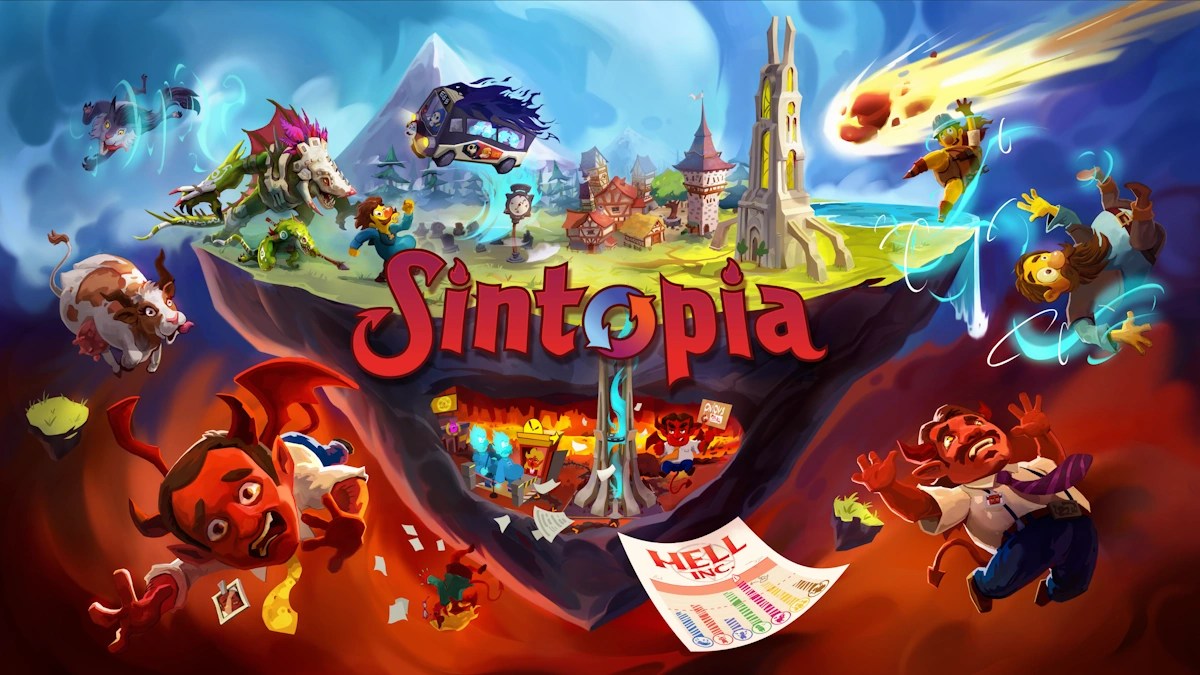
When Jean-Paul Sartre wrote “hell is other people” in No Exit, he wasn’t just complaining about bad company. In the play, three people share a room for eternity, feeling trapped under someone else’s gaze, unable to escape their judgment and, as such, unable to define themselves on their own terms. That alone is enough to make it unbearable.
Sintopia manages to accidentally recreate that very feeling through its slow pacing and incredible rigidity, as well as a parade of systems like worker strikes, research bottlenecks, and constant upkeep costs to manage that feel less like meaningful challenges and more like enforced busywork.
The result is a strange kind of design purgatory: a management game about chaos that refuses to let you take control. Like Sartre’s characters, you’re stuck within rules you didn’t choose, answering to expectations you didn’t set, and wondering why something that should feel creative and free ends up feeling so… punishing. Perhaps that’s the idea? It’s about hell, so let’s punish the player?
What’s all the more frustrating is that there is a good game buried in here, though. There is a version of Sintopia that could be good if it just let go of my hand and let me play the game the way I want to play it. The issues I had with the game weren’t just present in the campaign but also in the sandbox mode. I really wanted to like this game. It’s a cool concept, but… Well, you’ll see.
Developer: Piraknights Games
Publisher: Team17
Genre: Management, God Sim, Citybuilder
Release Date: April 16th, 2026
Reviewed on: PC
Available on: PC
Copy was provided through the publisher.

At its core, Sintopia is about managing the underworld while indirectly influencing the overworld.
When the chickpea-based lifeforms known as Humus die, they’re sent to hell, where you build infrastructure to process their sins and reincarnate them. The gameplay loop revolves around placing sin-processing buildings, organising logistics, and keeping the whole system running efficiently. Souls that linger too long accumulate more sin, so optimisation is key. You need to reincarnate souls, or else all hell breaks loose in the overworld. Literally.
On paper, it’s a compelling idea, but in practice, it’s weighed down by unnecessary friction and a lot of arbitrary systems that really are a detriment to the experience.
The game revolves around three currencies: Purgadollars for construction and wages, Faithcoins for overworld abilities, and Haeros for research. While this sounds like a layered system, it mostly slows down everything. Progress is gated at nearly every step, and getting your economy off the ground takes far longer than it should.
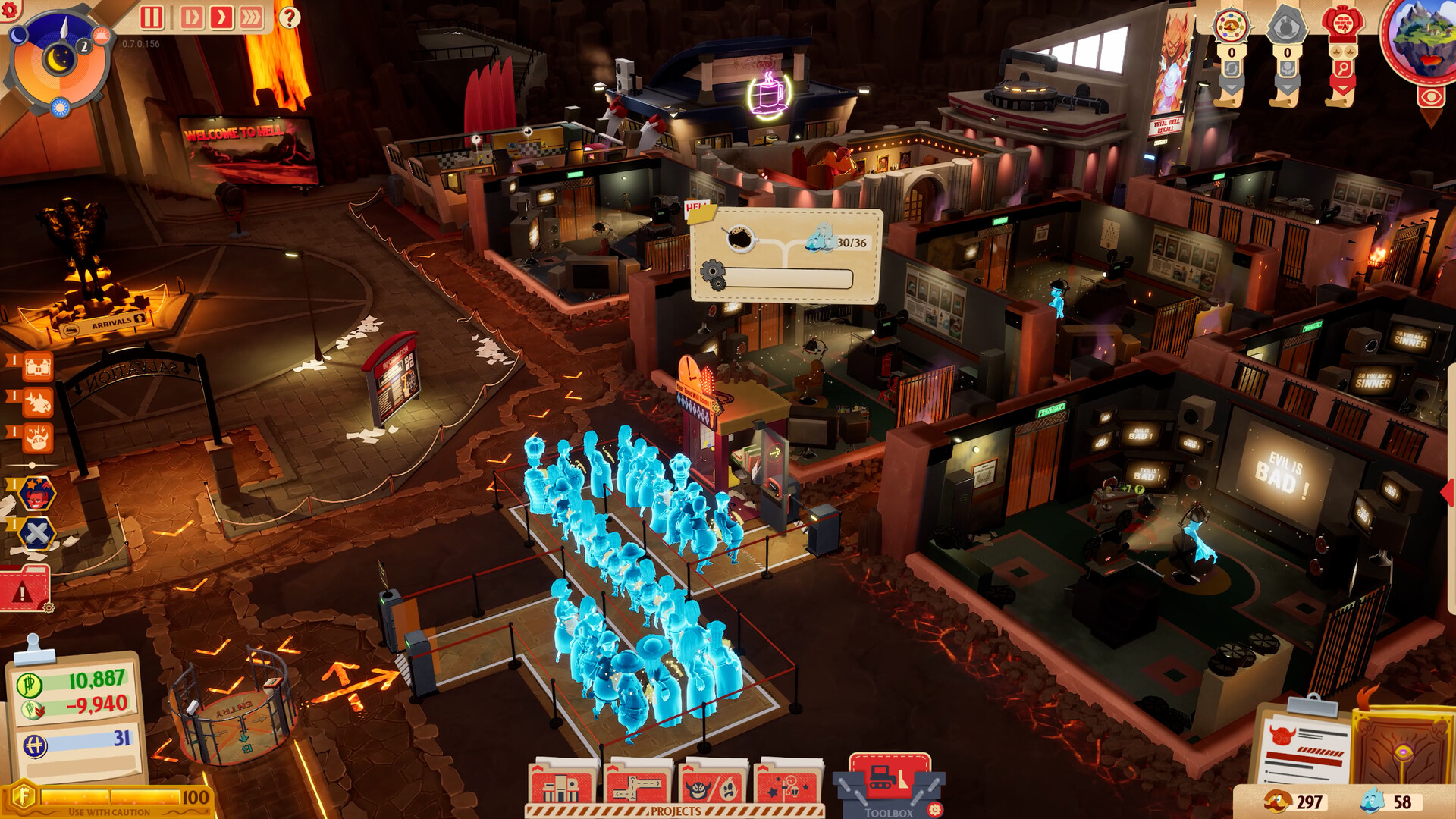
What I mean by this is that you start out with limited purgadollars, as is the standard in most games like this one. When you send souls through the Omnisin Doctors or the more specialised buildings for each sin type, you generate further Purgadollars which then have to be used to expand, pay the imployees (yes, that’s intentional) and deal with the upkeep.
It makes sense that you pay your workers and have to deal with upkeep, but it takes a long time to break even, especially since the game can only be sped up so much for whatever reason. You get some extra income through the hellbus bringing folks in but you can’t just kill all the humus for some minor income and you can reduce upkeep using buildings but research requires Haeros which requires you to reincarnate souls with low sins which heavily depends on your infrastructure.
The overworld, which should provide variety when you’re waiting for the economy to get started down below, feels fairly underdeveloped, though, and hence fails in providing a much-needed bit of respite.
Yes, you can influence events with abilities like lightning strikes or environmental manipulation, and at first, this is entertaining: You know… dropping cows on unsuspecting Humus or spreading fire by knocking over torches using wind. But these interactions are shallow and limited, and the slow generation of Faithcoins discourages experimentation. It would be better if you slowly regenerated Faithcoins over time, albeit at a limited rate. Cult followers can donate Faithcoins as an offering to you, but getting that cult going, again, takes time… a lot of time. There are buildings that process souls for faithcoins but they don’t help with reducing sin, so it feels almost pointless to build those eventually, given how much more you get through cult offerings.
There is definitely a clear creative vision here, but the execution often undermines it, sadly.

Worse yet, you have almost no meaningful control over the simulation. The Humus operate under rulers with different priorities, strengths and weaknesses, but even when those align with your goals, their behaviour is inconsistent. Each type of ruler (based on the different sins) has characteristics that should be helpful depending on your needs. If danger is afoot, having a lot of soldiers is good. If disease is a problem, having a lot of doctors would be lovely.
As I said, though, this is just on paper and in reality, a warlike ruler might fail to build an army in time, while a greedy one seems to accomplish nothing at all – or at least, you don’t feel the impact of having “more merchants” or “more doctors” in the realm. You can kill the ruler to cycle through to the next one, but it feels meaningless. I’d like to actually shape the world with my powers directly or indirectly, but instead, I’m just stuck reacting to it. There are worlds that fell apart because I had all the garrisons but no soldiers, and there was literally nothing I could have done about that. My economy was good, the cityscape was thriving, and I’m just left there watching it all fall apart because the game refuses to operate on the very terms it defined in the first place.
Thus, due to the limited influence you have on the actual simulation or god sim portion of Sintopia, most of your time is spent in hell, managing the infrastructure, even though the game supposedly is about both sides of the coin here. There is a duality that gets pitched, but effectively, it’s just about hell anyway.
The overworld is shallow and the underworld is infuriatingly slow and annoying.
If your systems aren’t perfectly optimised, sins spiral out of control. Deviants emerge, disrupting your operations, and they may eventually turn into demons that actively sabotage your progress. What starts as a manageable problem can quickly snowball into chaos, sometimes to the point of effectively softlocking your run. You could just kill all the sinners (if you have the faithcoins to spare, that is), but since barbarians, the lizard-folks known as Guacas (see what they did there?), and even zombies might attack you in the overworld, you kind of need the soul population to reincarnate often and quickly. There is a meta in place that definitely works and is easy to follow but that’s also pretty boring for a city builder/god sim.

Trying new layouts or strategies often leads to failure, because the game punishes inefficiency so harshly. Some aspects of the game aren’t explained too well, like the importance of waiting booths and how they will just send folks along the path when an opening appears. Whether whatever you are trying to achieve works out or not takes ages to realise, since the sin buildup can really clog up your systems and doom a playthrough, as it just keeps snowballing out of control with few ways to correct mistakes and issues. Worse yet, you don’t realise that a problem is brewing a lot of the time since there are no meaningful stat panels for traffic, throughput, and the like in an easily accessible overview.
The hell portion of the game is basically a citybuilder, and, in my opinion, citybuilders are all about solving problems. Getting the traffic to flow properly so that goods get to the industry, or trading for the sake of acquiring resources that you cannot produce yourself yet. Stuff like that. As you solve a problem, something else catches your eye, and you’re trying to just make your way through the game bit by bit, solving problems you encounter. Most tycoon games work in a similar manner. Sintopia doesn’t.
With upkeep costs scaling aggressively and without much transparency, Sintopia is all about “causing as few problems as possible while you follow a meta build of sorts” rather than solving problems.
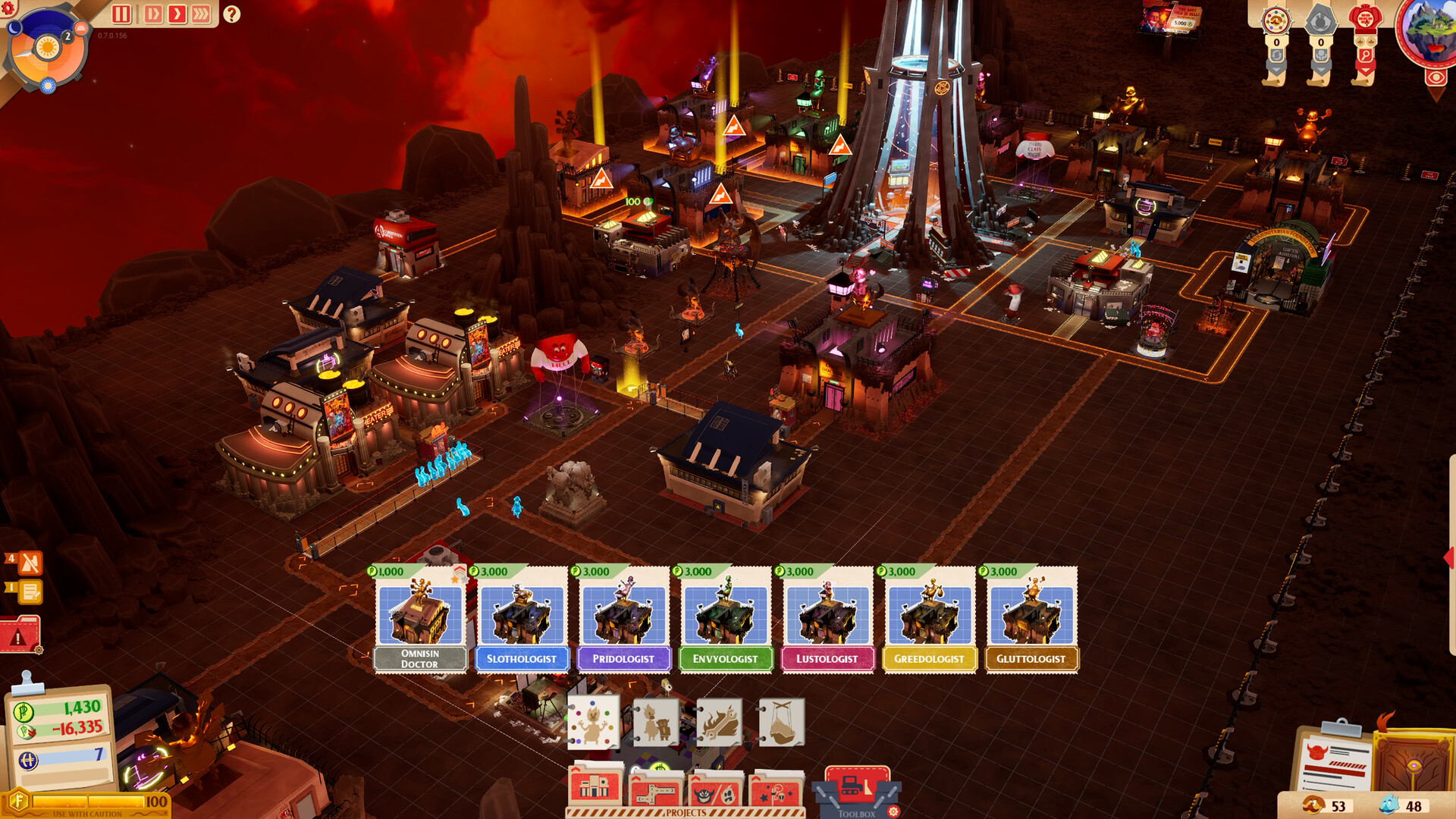
Later, money becomes irrelevant, but by then the damage is done: the early game feels punishing and the midgame feels like damage control. Worker strikes and system breakdowns don’t feel like challenges to overcome, but like arbitrary setbacks designed to slow you down. I mean, I’ll just make big purchases right before pay time and then wait out their ensuing strikes so that I can generate money. It’s more efficient to it this way than just play the game…
Once you’re in the late game and don’t care about upkeep because you just have so much disposable income, you’re just watching things unfold with no real incentive to further improve efficiency. Don’t fix what’s not broken, right?
It’s a strange contradiction. The game wants to simulate a complex system, but it hampers your ability to correctly respond to situations that arise. Other games in the genre give you the tools to actually deal with these. It just feels jarring. Every sorter you introduce into a path will add a bit of delay. The Fear/Motivation system doesn’t seem to matter all that much in the grand scheme of things either, with fear slowing down workers but speeding up souls and motivation doing the opposite. It’s just too roundabout to function.
There are a lot of small issues with the game, and they pile up into one big mess. Yes, a lot of these issues are minor gripes but additively, they make up most of my experience at this point.

The writing doesn’t help either, as the game leans heavily into humour and self-awareness, often framing its mechanics as a satire of bureaucracy, which can feel like the developers mocking you, at times. The jokes rarely land. Dialogues tend to overexplain punchlines, dragging out bits long past their breaking point, often overstaying their welcome far more than necessary. Like, yes, Lili(th), I understand that you believe evils are relative and that bureaucracy is the most vile evil out there, but why do you keep going on and on about that joke. I already got the joke. It doesn’t get funnier when you explain it. It just gets worse.
On top of that, the game heavily leans on “topical” and even more contemporary references, from Lust demons modelled after OnlyFans creators to Pride demons being fallen angels wielding a “cancel hammer” as a punchline. These are meant to be broad satire, but they feel shallow at best and oddly pointed at worst. Sintopia doesn’t do anything with these “internet culture critiques”. The developers just point a finger at something and go “HA!”. Where’s the joke in that? References to one of Lovecraft’s most racist creations, an “imp lives matter” poster, casual sexism and pet names in dialogues, random general weirdness about trafficking (?) women, and other little bits and pieces like that don’t get contextualised or used in any artistic or meaningful way.
The developers have previously said that these inclusions aren’t meant to make a statement, and that they’re just “making fun of things”. But this defence only goes so far. When your humour consistently pulls from loaded cultural shorthand without saying anything meaningful about it, it stops feeling like satire and starts feeling careless.
Obviously, I don’t think that these inclusions can’t be in games or anything. No, on the contrary, games are art and if you have something to say, then say it. Please do! But the developers fear for all sides of the political spectrum and hence try to dodge the responsibility that comes with putting these references in the game in the first place.
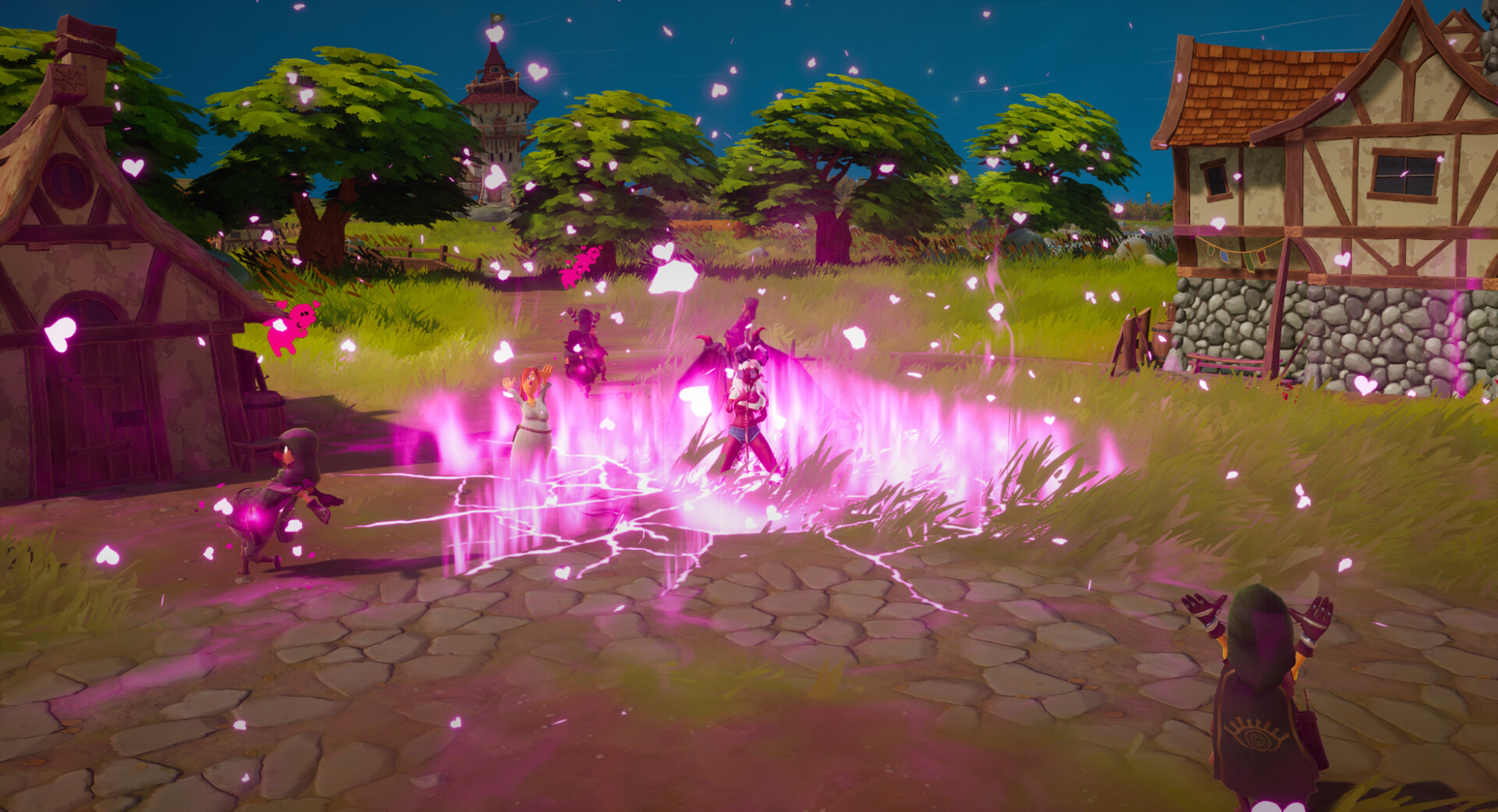
This is not to say that the game cannot be funny. Poking imps on their break so that they get to work faster (which is a nice nod to Dungeon Keeper) or how souls get punished at the specialised doctors, as well as the many different details inside of each building, add a lot of charm to the game. There is a ton of attention to detail in Sintopia and the developers really want you to just go in there and explore each nook and cranny to find all the funny eastereggs. I love that. Some of the campaign’s jokes did also get a reaction out of me… before they overexplained the punchline for way too long. But still! It’s a reaction!
In terms of its presentation, the game is also very nice to look at, with various biomes, cool house designs, and some decor options. I absolutely loved the soundtrack and still have “Welcome to Hell, Baby” stuck in my head even while writing this review. Sintopia has a ton to offer, which is why it almost feels vexing how much effort was put into designing the game while the gameplay and writing in their current state are so lacklustre.
All of this makes Sintopia feel like a game at odds with itself. It borrows ideas from classics like Dungeon Keeper and Black & White, blending them with modern management sim elements, and you can see the potential for an amazing title…
When everything briefly clicks, when your systems run smoothly, and when the chaos is under control – it’s genuinely satisfying. The game suddenly looks and feels like such an amazing time. I wonder in those moments why I even complained about the game in the first place. Whenever I got to points like that (after following the developer’s expectations, I guess), it was fun and rewarding, but those moments are rather rare… and it all comes down on you and suddenly sins start building up a lot, your king has gone mad, and all your waiting lines are filled to the brim while you don’t have any options to expand further.
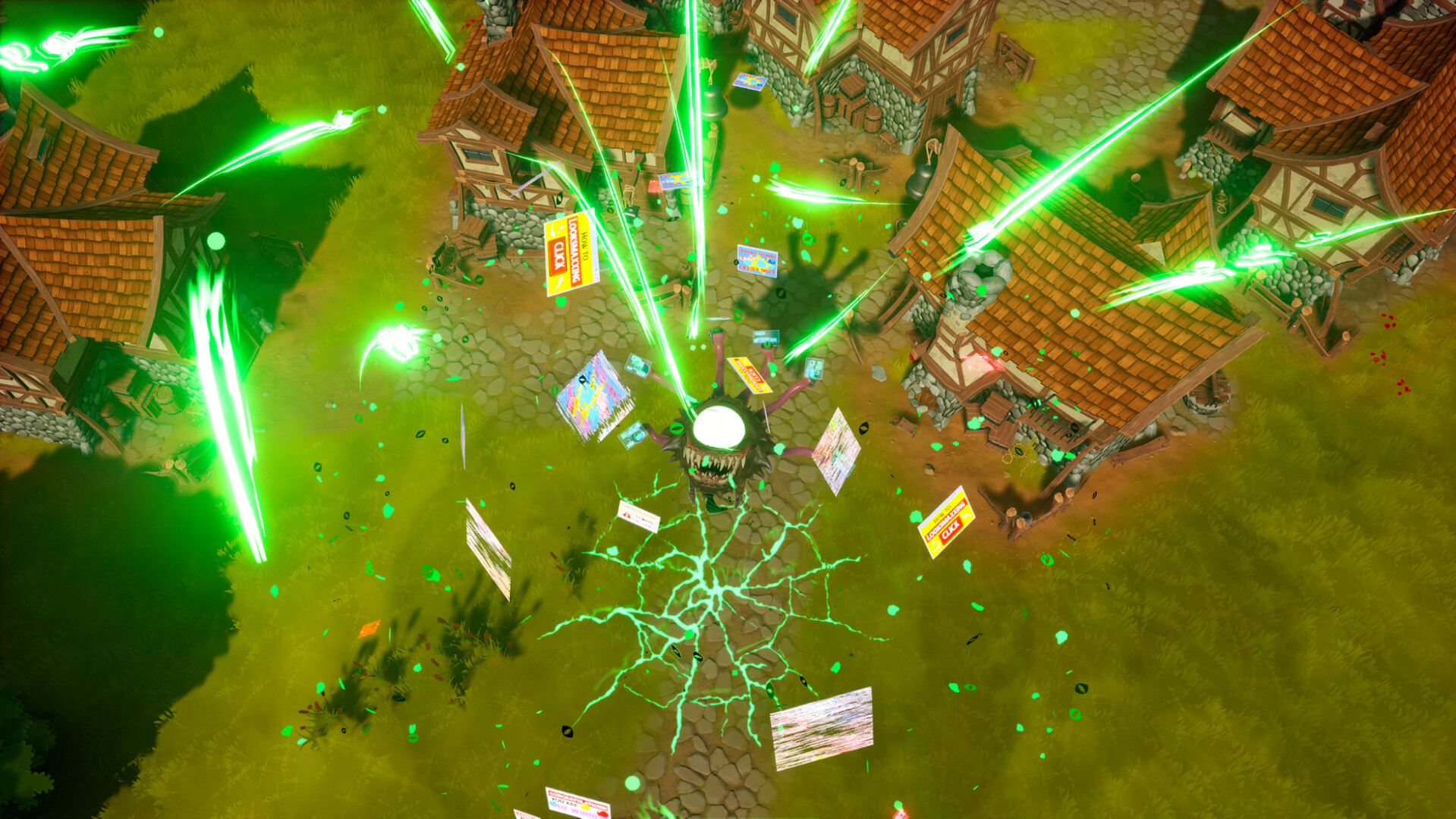
The campaign suffers from sudden difficulty spikes, while the sandbox and challenge modes drag on forever. Systems pile on top of each other without adding meaningful depth, and the lack of player freedom turns what should be a creative sandbox into a frustrating experience, not because it’s entirely bad, but because it gets SO CLOSE to being actually good.
I really wanted to love Sintopia. It’s charming, it can be funny at times, and it does have a ton to offer for people willing to engage with its details and explore the world… but there’s nothing to do in the overworld really and it just feels so punishing and void of any meaningful challenges. Honestly, being able to speed up faster and perhaps giving you the option to take out loans or something could work in the game’s favour.
I am sure that there is some version of Sintopia out there that trusts the player more and that embraces experimentation instead of punishing it. That version could have been something special. Instead, what we get is a game that feels like being stuck in someone else’s idea of how it should be played, never quite allowed to make it your own. After twenty hours, I didn’t feel challenged or engaged. I just felt done with it. I don’t think it’s a good sign when you play a game this much and with every session, you just feel like playing all sorts of other games that do it better than this one. Add to that some general weirdness with the non-commentary on current-day topics, and it just ends up not being my vibe. If you can look past all of those issues and having to restart multiple times and if you’re into suffering, perhaps a quick trip into this hellscape might be just for you.
Verdict: Sintopia is a hell-management game that could be so much better if it gave the player more freedom to act upon on top of extra breathing space. The excruciatingly slow pace robs you of a lot of the enjoyment that comes with seeing a civilisation grow, and it then further punishes you for inefficient layouts a few hours into it, rather than letting you resolve problems that do arise as you encounter them. The lack of freedom in combination with the shallow systems led me to experience a hell akin to Sartre's "No Exit" where I constantly felt judged by the developer's expectations that I play their game exactly how they want me to play it. It's a bummer, truly, because there is a good game underneath it all but it just needs so much more polish. On top of that, there are a lot of culturally charged references and "jokes" in the game that feel like they're supposed to offer political commentary but there's absolutely no power behind it to go through with it.
This post was originally published on Indiecator.
If you wanna get in touch with me, feel free to stop by for one of my Twitch streams. For business inquiries, please reach out via email.


Leave a Reply